Posts

Do graphic novels encourage reading?

After reading graphic novels such as Nevermore , a graphic novel featuring nine of Edgar Allan Poe's more popular horror stories, are you encouraged to read the original text? Does reading graphic adaptations persuade you to seek out other stories written by Edgar Allan Poe? Why or why not?

Media Punk'd by Poe

Edgar Allan Poe wrote a piece for the New York Sun about a "group of British adventurers who had built a propeller-driven balloon, had taken off to cross the English channel . . . and ended up being blown across the Atlantic to a beach in Virginia, thus effecting the first aerial transatlantic crossing. This was BIG news! The Sun's unnamed correspondent [Poe] was the first to . . . interview the intrepid airmen." Soon other reporters were scrambling "down to Virginia and began cranking out their own exclusive interviews with the [ballooning] Brits. There was only one small problem: There was no balloon, no balloonists, and no transatlantic crossing." But the papers didn't care "they just wanted a hot story, even if they had to make it up" (Bloom Puppets ). Do you think today's newspaper journalists just make up stories? Do you ever embellish your essays to make them more interesting?

What's your medium of choice?

Our society values the graphically visual medium. Even more so, we value graphics coupled with sound to receive information in the same way most of us navigate the world. Our news and entertainment is almost exclusively received via the television. It can be said that by diminishing textual mediums we have cheapened the word. When studying authors like Poe do you think graphic novels like Nevermore do justice to the word pictures we create as we read his texts? Why? Or do you think our imaginations can do far more justice to the terror Poe attempts to invoke on his readers? Why?

Fiction as Truth

Image
When Poe's story, "The Facts in the Case of M. Valdemar" was first published he failed to state that it was a fictional work. Instead he let his readers believe that through hypnosis a person could become trapped in their own body. In 1938, the Orson Welles' radio broadcast of the sci-fi fantasy "War of the Worlds" about aliens invading earth caused a nationwide panic. In Poe's case the public was prepared to accept the idea of performing surgeries using hypnotism as an anesthetic, a commonly reported phenomenon (albeit untrue). "War of the Worlds" played on the scientific explanation of a crowded universe where sentient alien beings living on Mars. Have you ever read a fictional work that you thought was true? Why did you believe it was true and what did it cause you to do?

The Pit

Image
Edgar Allan Poe's "Pit and the Pendulum" explores judicial corruption and torture during the Spanish Inquisition, while the updated comic Nevermore resets it in the modern era. How does the Iraq-war era effect the story's plot? Does your observation of the news and other media sources sway your thinking? If so, how? Is torture ever justified, or does torture let "all memory of freedom die . . . , smothered under a breathless weight of night"?

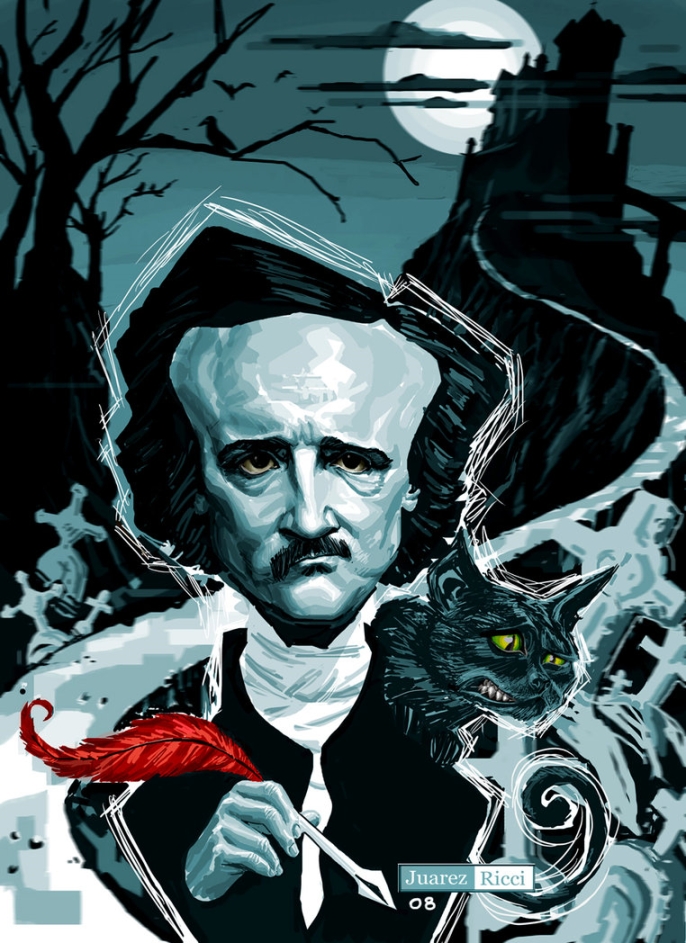
Edgar Allan Poe 1809-1849

Image
Why do you think Edgar Allan Poe became a horror writer? Poe was orphaned as a toddler, but was taken in by a wealthy family. Although never formally adopted, his new mother loved him very much, but when she died, Poe was left with a stern disciplinarian of a foster father. Poe dropped out of school because of gambling debts. He was disinherited by Allan after quarreling about his inheritance. He joined the military and was court martialed (on purpose). His childhood sweetheart married another man, so he married his 13-year-old cousin, who died young. He pretty much lived his adult life in poverty moving from one writing/editing job to the next. How do you think these events led to Poe's preoccupation with horror and its related themes? What events from your own life led you to your chosen career?

A Little Terror Will Help You Grow Up Big and Strong

Image
As a child we are frightened by creepy clowns and the evil hiding under our beds or the bogeymen inhabiting our closets. Our threshold for terror lies in the innocence of childhood. From walking home in the dark after a vampire film festival to getting lost at the shopping mall, dread dwells in the unexpected as we climb the scaffolds of our mind to the noose of terror that awaits us. What's your fondest childhood fear?