Posts

Showing posts with the label Rippin' Good Reads

The Great Gatsby New Millenium Style

Image
Keith Patterson recently created an infographic that explores how the 1920's world of Jay Gatsby stacks up against the rich and famous today -- specifically the rich and famous who are playing the roles of the Roaring Twenties uberwealthy characters in the recently released Great Gatsby movie directed by Baz Luhrmann. Click here to view the full-size original over at Electric.com . According to Patterson, "Fitzgerald's young artist, writer and multi-talented friends inspired his classic novel about one of America's most indulgent periods."  How do you think the nouveau riche of the new millenium compare to those at the beginning of the 20th century?  How do you think our hip-hop, movie star, reality TV megalomaniacs compare to the characters of The Great Gatsby ?   How do books reflect culture?  If you wrote an updated version of The Great Gatsby where would you set your book and how would you define your characters?

Naughty, Naughty

Image
Have you read Lord of the Rings ? How about The Great Gatsby or The Catcher in the Rye ? If you have then you are reading banned books. In honor of Banned Books Week (Sept. 30) here are the top twenty banned "classic" books according to the American Library Association (ALA) . 1. The Great Gatsby , by F. Scott Fitzgerald 2. The Catcher in the Rye , by J.D. Salinger 3. The Grapes of Wrath , by John Steinbeck 4. To Kill a Mockingbird , by Harper Lee 5. The Color Purple , by Alice Walker 6. Ulysses , by James Joyce 7. Beloved , by Toni Morrison 8. The Lord of the Flies , by William Golding 9. 1984 , by George Orwell 11. Lolita , by Vladmir Nabokov 12. Of Mice and Men , by John Steinbeck 15. Catch-22 , by Joseph Heller 16. Brave New World , by Aldous Huxley 17. Animal Farm , by George Orwell 18. The Sun Also Rises , by Ernest Hemingway 19. As I Lay Dying , by William Faulkner 20. A Farewell to Arms , by Ernest Hemingway Why are books b...

The Great Gatsby Graphic

Image
Did you read F. Scott Fitzgerald's The Great Gatsby in high school or college? Did you have a hard time keeping track of who is who? SomethingSoSam.com created a slick art deco Gatsby Character Map to help you keep track. But SomethingSoSam didn't stop there, there are also some graphics of memorable Gatsby quotes , like this one: To finish off this trilogy of visual fun, here is a video with a little bit more about the Gatsby characters . . . A Look Into the Characters of The Great Gatsby from SomethingSoSam on Vimeo . It's obvious this graphic artist is passionate about The Great Gatsby . Warner Brothers would be well served to hire SomethingSoSam to create the posters for their movie slated for release December 2012. It is billed as an "American 3D romantic drama film", and stars Leonardo DiCaprio as Jay Gatsby, Carey Mulligan as Daisy Buchanan, Tobey Maguire as Nick Carraway, Joel Edgerton as Tom Buchanan and Isla Fisher as Myrtle Wilson....

Elmore Leonards' Rules for Writing

Image
Elmore Leonard, author of Get Shorty , Out of Sight , and the small screen's Justified , offers some advice to would-be writers and even though his advice is for budding novelists, a great writer is just a great writer. Take Elmore Leonard's advice when writing your college essays. Some of Leonard’s suggestions appeared in a 2001 New York Times article that became the basis of his 2007 book, Elmore Leonard’s 10 Rules of Writing . Here are the basics: 1. Never open a book with the weather. If you open an essay with the weather, it better be a paper for a meteorology class. In other words, don't begin with a "It was a dark and stormy night." 2. Avoid prologues. Hmmm, prologues are a wind up to the action. Think of a prologue as your introduction. While an introduction is important you don't want to give too much away (or bore your readers with information that is common knowledge). Tell you reader what your paper is about and then get to it. ...

Ray Bradbury Predicted the Future

Image
When reading or watching science fiction we often run across products or futuristic visions. But if one looks at the past works of science fiction, say from sixty years ago, we can see just how prescient a certain author or cinematographer is or was. Ray Bradbury was one of those prescient visionaries that predicted among other things: spy satellites, automatic teller machines, cell phones and flat screen TVs. Many of his books are classics: "There Will Come Soft Rain," and Fahrenheit 451 are just two. As you look at this infographic from Ria Novosti , think about recent creators and their predictions. What do you see in science fiction that will become a reality for you or your children. Personally, I want my hover car!

Top 10 Most Read Books

Image
Top 10 Books by Jared Fanning 1. The Holy Bible 2. Quotations from Chairman Mao 3. Harry Potter 4. The Lord of the Rings 5. The Alchemist 6. The DaVinci Code 7. The Twilight Saga 8. Gone with the Wind 9. Think and Grow Rich 10. The Diary of Anne Frank Information graphics are great additions to papers, especially ones that look this good. They can convey a massive amount of information in the briefest glance. Here's what I mean. If you wrote The Top 10 Most Read Books as a paragraph it would begin, "The top ten most read books in the world refers to the number of books sold, not printed. The number one book is The Holy Bible which sold 3,900,000,000 copies. The number two spot is occupied by Quotations from Chairman Mao Tse-Tung , selling 820,000,000." You would have to read a whole lot more before you got to "The Diary of Anne Frank is the 10th most-read book in the world having sold 27,000,000 copies." See what I mean? This co...

2012 Summer Reading

Image
The folks over at teach.com created a summer reading flow chart just for you! In between summer jobs, socializing, and sleeping, you may find yourself in need of a book - many of these texts are available free online, or even better free from your local library. This list contains fiction and non-fiction books for all tastes. There are a few graphic novels, although I would add Watchmen if you haven't read it yet. Think about the classes you need to take in the Fall. If you have to take U.S. History, I can definitely recommend McCollough's John Adams . For you Administration of Justice majors, try Truman Capote's In Cold Blood . Something to consider, even if you aren't looking forward to psychology, sociology, or English (how can that be?), these are all GREAT books that will keep you entertained. So what's on your reading list? Via Teach.com and USC Rossier Online

Ray Bradbury R.I.P.

Image
Ray Bradbury died Tuesday, June 5, 2012 at the age of 91. Remembered for his science fiction works such as Fahrenheit 451 , The Illustrated Man , and The Martian Chronicles , Bradbury was a profilic writer who helped science fiction escape "pulp" status and legitimizing a whole genre. In 2001, Bradbury offered twelve pieces of advice to aspiring writers. Even though most of your college writing will be essays which many see as not very creative, if you want your Professor to be engaged (and therefore entertained--that's a good thing) in what you're writing take Bradbury's advice from Open Culture : >>" Don’t start out writing novels. They take too long. Begin your writing life instead by cranking out “a hell of a lot of short stories,” as many as one per week. Take a year to do it; he claims that it simply isn’t possible to write 52 bad short stories in a row. He waited until the age of 30 to write his first novel, Fahrenheit 451. 'Worth ...

Science Fiction or Fantasy?

Image
I was wondering what I was going to read this summer when a student added NPR's Top 100 Science Fiction and Fantasy Books to a class discussion board. Not to be outdone, SF Signal turned NPR's list of Top 100 Science Fiction and Fantasy Books into a flowchart. But SF Signal didn't stop there. They turned the flowchart into an interactive list. To begin, you must first decide whether you want to read science fiction or fantasy. After clicking science fiction, you are asked about cyberpunk (Gritty noir, Neo-Victorian, or Samurai). If Neuromancer 's not your thing, or you've already read it (which I suspect), then you can blast into space. At the "start" screen, you are also asked if you like neither and instead "only read books with pictures." Hmmmm, do I detect hoity-toity comic phobia? If you choose to read "picture books", then you get to choose between Heroes ( Watchmen ) and or "Master of Dreams" (Neil Ga...

Alice in Peepland

Image
Alice in Peepland is the Chicago Tribune's 2011 (People's choice) winner. What a misnomer! Of course, this is the Peeple's choice winner! This is the Dispeep version, there's no Johnny Peep as the Mallow Hatter to scare the goo out of you. We can clearly see Alice as she waits for the Queen of Carnuba to wax the groundpeep through the Jackrabbit of Spades.

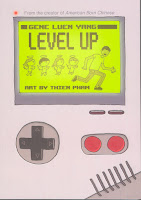
Level Up Debuts with Epic Draw-Off

Image
Level Up, the newest work from writer Gene Luen Yang and artist Thien Pham, is now out, and recently the two creators set out on a promotional tour.  Here's the scoop on the epic draw-off that ensued, and much more.  By Dore' Ripley. Level Up debut at Graphic Novel Reporter. What are you reading the summer?

After Johnny Bunko . . .

Image
Here comes the summer with its warm weather, sunny beaches, and amusement parks. Before setting off on a long overdue vacation, think about how The Adventures of Johnny Bunko changed your view about the career world? How will you handle changes to your plans? Are you willing to make adjust your plan to accommodate fundamental and instrumental motives? Instead of becoming a doctor or a musician, can you see yourself working in those worlds in a different capacity? Say a doctor to the "stars" or a music teacher?

There is no plan?

Image
Diana in The Adventures of Johny Bunko says, "There is no plan." The author, Daniel Pink, is not saying "Don't make a plan." He's simply saying, "Don't count on all (or any) of your plans working out." Many students and young professionals have a hard time coming to terms with this quote, but if you think about it realistically it seems apparent. For example, do you think that 50 percent of the people who get married plan on getting divorced? No! But that's the average rate of failed marriages in the U.S. So, after thinking about "There is no plan" versus "Don't count on all your plans coming to fruition," do you have a different view of what your future holds? Are you willing to adjust your plans in order to make way for the future?

Leave an Imprint

Image
No one lives forever. As you get older, you look back at your life and ask yourself, "Did I make a difference?" "Did I contribute something?" "Did my being here matter?" In other words, did you do something that left an imprint? Do you ask yourself these big questions? Or do you avoid them? And more importantly, what imprint do you want to leave? Are you going to be a force for positive change through your life and career choices?

Make Excellent Mistakes

Image
What kind of excellent mistake have you made that led you to a later success? As Daniel Pink, author of The Adventures of Johnny Bunko: The Last Career Guide You'll Ever Need says, "The most successful people make spectacular mistakes--huge, honking screw ups! Why? They're trying to do something big. But each time they make a mistake, they get a little better and move a little closer to excellence." Are you willing to make mistakes on your road to success?

Persistence Trumps Talent

Image
How can persistence trump talent? Talent alone won't get the job done and for some people, work will out do talent. But if you never try you'll never know! As college students, you are going to have to be persistent to gain the talent you will need to succeed at your career goals. Great musicians, artists, and authors may be born, but they won't get anywhere if they do not practice a lot. Is there a time in your life when you succeeded because of your persistence, rather than your talent? Explain.

Fundamental or Instrumental?

Image
Are you a person who has chosen his or her career path for instrumental reasons? Do you do things, as Daniel Pink explains, "because you think it's going to lead to something else, regardless of whether you enjoy it or it's worthwhile"? Perhaps, it's a high paying career choice? OR Are you a person who has chosen his or her career path due to fundamental reasons? Have you chosen your college major because it will let you do interesting work even you don't know exactly where it will lead? Why do you think you are a fundamental or instrumental kind of person?

Do graphic novels encourage reading?

After reading graphic novels such as Nevermore , a graphic novel featuring nine of Edgar Allan Poe's more popular horror stories, are you encouraged to read the original text? Does reading graphic adaptations persuade you to seek out other stories written by Edgar Allan Poe? Why or why not?

The Last Blog . . .

Image
. . . for the quarter. Randy Pausch, author of The Last Lecture (www.hyperionbooks.com), realized he didn't give his last lecture because he wanted to. He gave it because he "had to." Like Spiderman, Paush believes "with great power, comes great responsibility." As you read the final chapters of The Last Lecture , how would you describe the legacy or message left by Randy Pausch?

Socially Mobile Grinders

Image
David Brooks in "A Nation of Grinders" ( RC,WW 543-547) asks readers, "[H]ow about Abraham Lincoln as the defining capitalist figure of our age?" (543). His answer, "That middle-aged Lincoln represents all the sometimes homely but invariably dreamy pushers who are what American striving is really all about" (543). The typical American success story does not consist of the billion dollar deal signed behind the doors of mega-corporate board rooms, but comes from "the need to actually execute and finish your strategies" at companies where the culture "encourages the Lincolnian virtues of simplicity and humility." In other words, work hard and do a good job, no matter what your job title. Further, when practiced, this "social mobility reduces class conflict because each person can build his own fortune, rather than taking from the fortunes of others" (547). What's your response to the notion that "each person...